A Comparison of Optical Biometers Used in Children for Myopia Control

AUTHORS:

Mattern, A. I., Neller, K., Devenijn, M., Schwahn, H., Langenbucher, A., Seitz, B., & Kaymak H.

PUBLICATION:

Klin Monbl Augenheilkd. 2023 Nov;240(11):1306-1313. doi: 10.1055/a-2117-9335. Epub 2023 Jun 26.

Study Purpose

To analyze the repeatability and reproducibility of biometric data obtained with the IOLMaster 700, Myopia Master, Myah, and Lenstar LS900

Overview

Study Design

    Retrospective study

# of Eyes/
Patients

• 44 eyes of myopic children (11.1 ± 2.4 yr) with a spherical equivalent of − 3.53 ± 2.35 D • Subset of 16 subjects used to assess repeatability of devices

Study Device

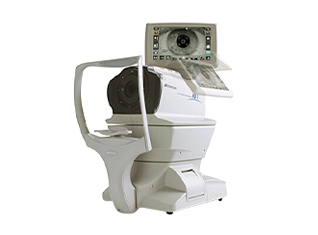
  • MYAH (Topcon, Tokyo, Japan)
  • Myopia Master® (Oculus Optikgeräte, Wetzlar, Germany)
  • IOLMaster® 700 (Carl Zeiss Meditec, Oberkochen, Germany)
  • Lenstar LS900® (Haag-Streit, Koeniz, Switzerland)

Outcome Measures

Repeatability and intra subject reproducibility of biometric data, axial length (AL) and corneal parameters (steepK, flatK, meanK, vectors J0, J45), for the 4 devices

Results

  • All eyes (n = 44) were measured with the IOLMaster at least once. This biometer was chosen as the reference for the comparison and to assess reproducibility
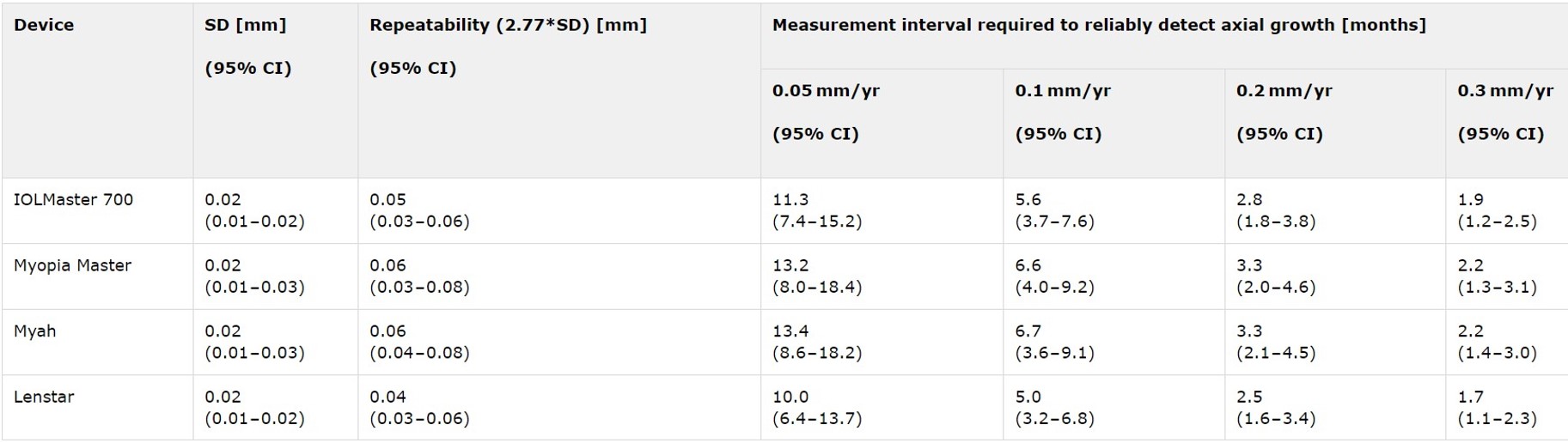
  • All biometers showed good repeatability in AL measurement, with values ranging between 0.04 to 0.06mm. Any AL measured with the Lenstar was, on average, longer by 0.02mm compared to the AL measured by the IOLMaster (p < 0.001) (Table 1)
  • For reproducibility of AL measurement, Myopia Master and Myah were in close agreement with the IOLMaster, except for Lenstar, which significantly deviated from the IOLMaster by 0.02 mm (p 

IMOvifa reduced measurement time by

39%

TABLE 1

TABLE 1.

Overview of the intra-subject SD, intra-subject repeatability (2.77*SD), and the calculated time interval required between two axial length measurements for different axial growth rates to be reliably detectable. Adapted from Klin Monbl Augenheilkd. 2023 Nov;240(11):1306-1313. doi: 10.1055/a-2117-9335. Epub 2023 Jun 26.

Conclusions

• Good agreement was observed between all the biometers • When assessing myopia progression in children, a time frame of at least 6 months between the AL measurements is advisable in order to reliably determine any deviation from a normal growth pattern


Product Comparison

Rotary Prism
Autorefraction

Keratometry

Auto Measure

Auto Right/Left

Full Auto
Align/Measurement

Rotary Prism
Autorefraction

Keratometry

Corneal Topography

Auto Measure

Auto Right/Left

Full Auto
Align/Measurement

Rotary Prism
Autorefraction

Keratometry

Auto Measure

Size and Weight

Height
XX Inches

Width
XX Inches

Depth
XX Inches

Weight
XX Pounds

Height
XX Inches

Width
XX Inches

Depth
XX Inches

Weight
XX Pounds

Height
XX Inches

Width
XX Inches

Depth
XX Inches

Weight
XX Pounds

Lorem Ipsum

X.X”

360° Rotating
Touchscreen

Control Lever

X.X”

LCD Screen Panel

Wavefront

Control Lever

8.5″

LCD Screen Panel

Lorem Ipsum

EMR

EMR Connectivity

Corneal Aberrometry

Ocular Aberrometry

Pupillometry

Tear Film Assessment

Viewer Software Available

EMR

EMR Connectivity

EMR

EMR Connectivity

The Topcon Healthcare Ophthalmology Solution

Lorem ipsum dolor sit, consectetuer adipiscing elit, sed diam nonummy.

The Topcon Healthcare Myopia Solution

Lorem ipsum dolor sit, consectetuer adipiscing elit, sed diam nonummy.

Fundus Cameras

Lorem ipsum dolor sit, consectetuer adipiscing elit, sed diam nonummy.

Fundus Cameras

Lorem ipsum dolor sit, consectetuer adipiscing elit, sed diam nonummy.